

AI Speaks Terraform Like a Tourist
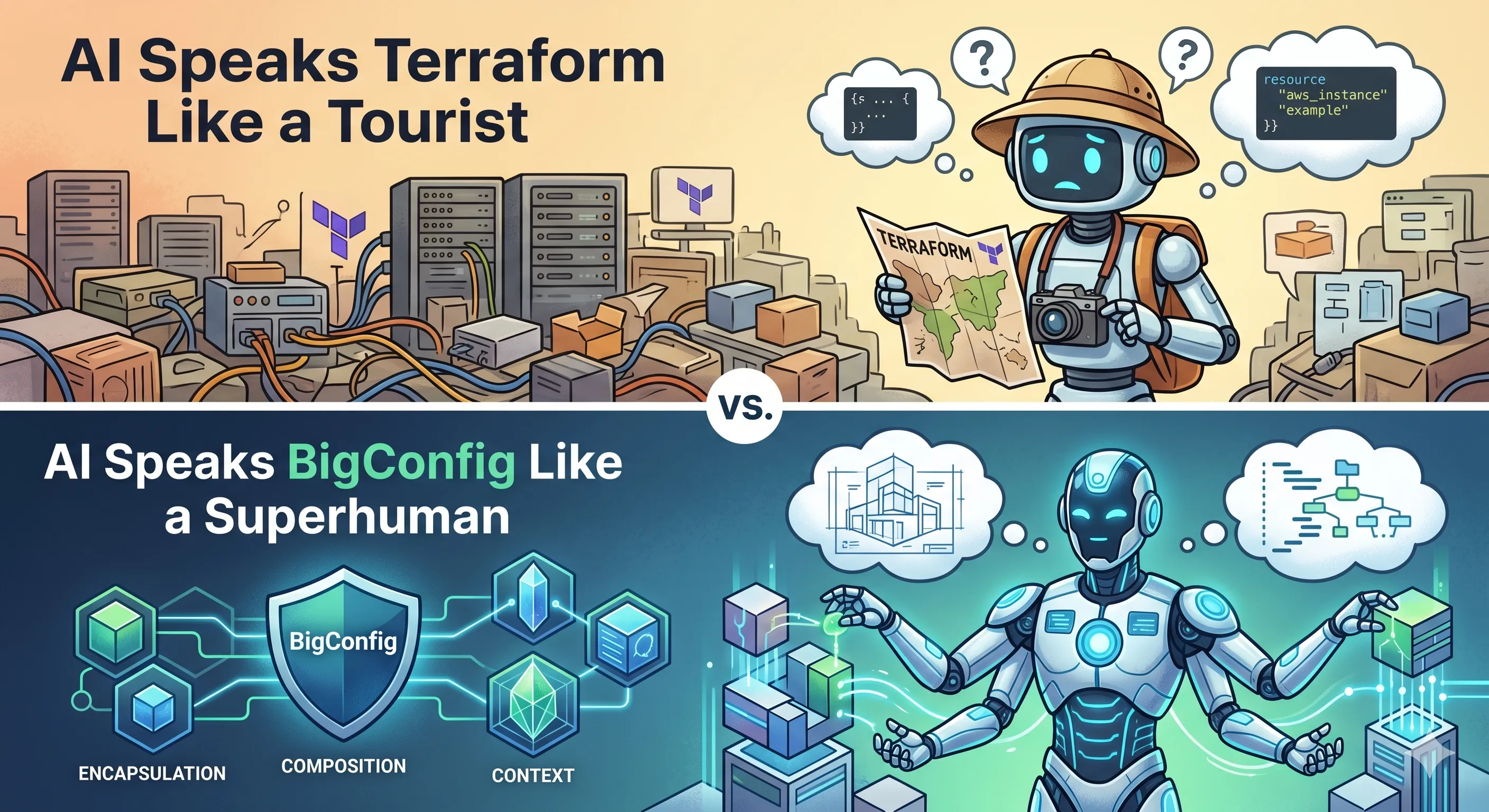

I recently stumbled upon a promoted post for IaCConf 2026 that gave me pause. The headline was claiming that “AI Speaks Terraform Like a Tourist”.
It’s a comforting thought for many, but it gave me cold feet. Seeing “1,000s of IaC practitioners” gathering to discuss this makes me wonder: How many of them will still easily find a new job in a year?

The “Pre-React” Era of DevOps
Section titled “The “Pre-React” Era of DevOps”We often find comfort in the fact that AI currently struggles to maintain complex Terraform repositories. We assume the models just aren’t “smart” enough yet. But I think we’re misdiagnosing the problem.
The struggle isn’t a lack of AI intelligence; it’s a lack of abstraction.
DevOps today is stuck in its own “pre-React” era. Think back to early web development: we separated code by technology—a folder for JS, one for HTML, and one for CSS. Then React arrived, introducing components and encapsulation. Suddenly, the “how” was hidden behind a functional “what”.
Current DevOps often practices separation by technology instead of concerns. This creates a lack of abstraction, forcing practitioners to curate nearly identical Terraform files across different companies, requiring massive amounts of human capital just to manage the boilerplate.
Why the “Tourist” Becomes a “Superhuman”
Section titled “Why the “Tourist” Becomes a “Superhuman””If AI speaks Terraform like a tourist, it’s because it’s being asked a task that is hard even for human intelligence. However, I’ve noticed a shift: AI speaks BigConfig like a superhuman.
I’ve had to accept that tools like Claude Code are already operating BigConfig better than I can. The reason is simple: BigConfig provides abstractions similar to React components.
- Encapsulation: AI doesn’t get lost in the weeds of low-level resource declarations.
- Composition: It can compose high-level abstractions to build complex systems.
- Context: When the “boring” details are abstracted away, the AI can focus on the architectural intent.
Conclusion
Section titled “Conclusion”We are at a crossroads similar to the one web developers faced in 2013. You can either be the developer who insists on manually manipulating the DOM, or you can be the one who learns to build with components.
The “tourist” phase of AI in DevOps is a temporary byproduct of our own messy, unabstracted architectures. As we move toward higher-level abstractions like BigConfig, the barrier between “intent” and “infrastructure” will vanish. The practitioners who thrive in 2027 won’t be those who can write the most clever HCL from scratch, but those who can design the abstraction that AI is already equipped to manage today.
Would you like to have a follow-up on this topic? What are your thoughts? I’d love to hear your experiences.