Skip to content

Blog

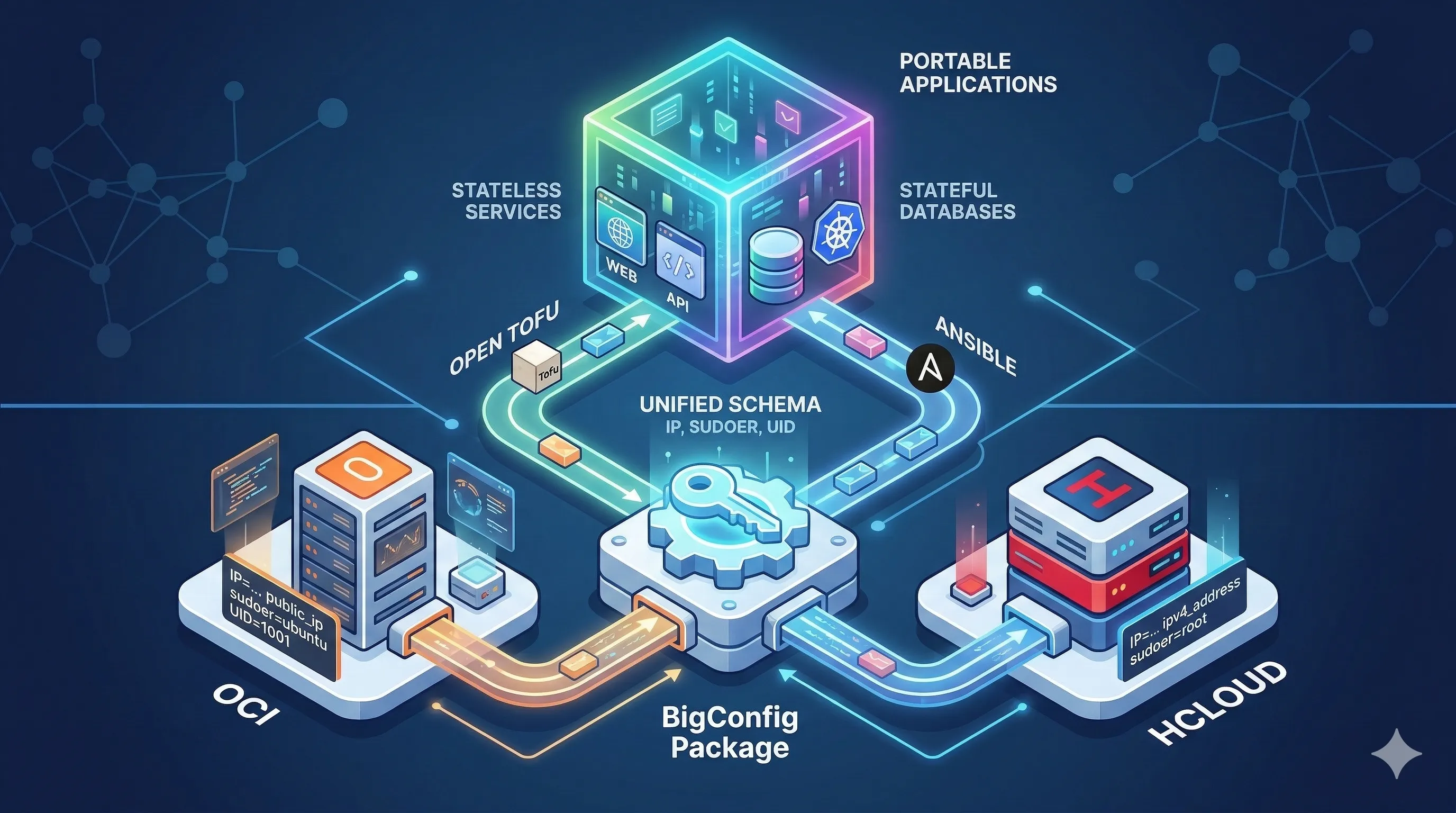
The Power of Framing: Why BigConfig is Rebranding as a Package Manager
Package Manager

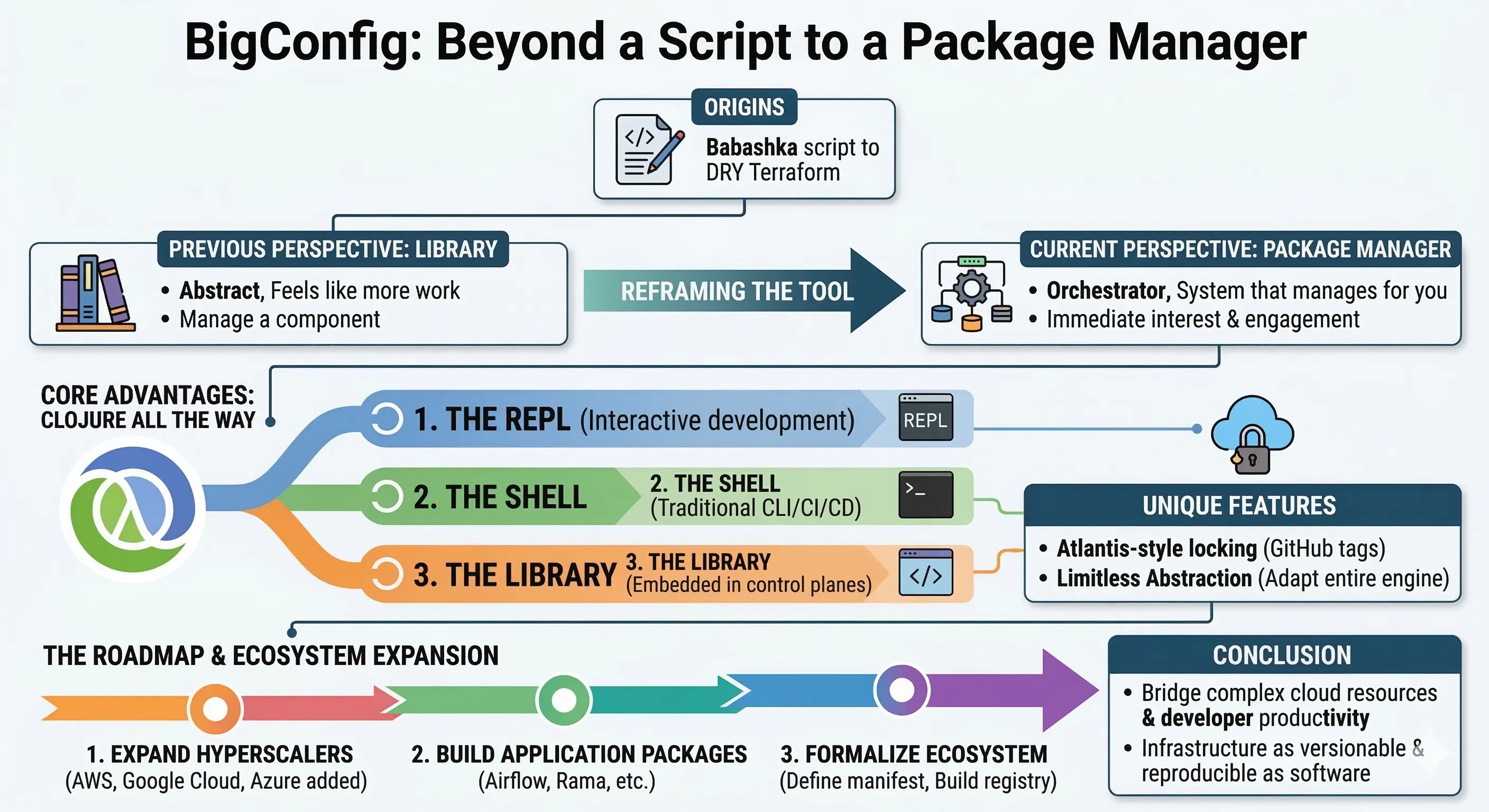
BigConfig started as a modest script to simplify complex Terraform projects, but it has grown into something far more ambitious. By moving beyond the “library” mindset and embracing the role of a package manager for infrastructure, BigConfig overcomes the traditional barriers of language adoption. This article explores how a unified Clojure-based workflow—spanning the REPL, the Shell, and the Library—offers a total solution for developers tired of juggling fragmented YAML templates and rigid deployment schemas.
Simple over easy for operations

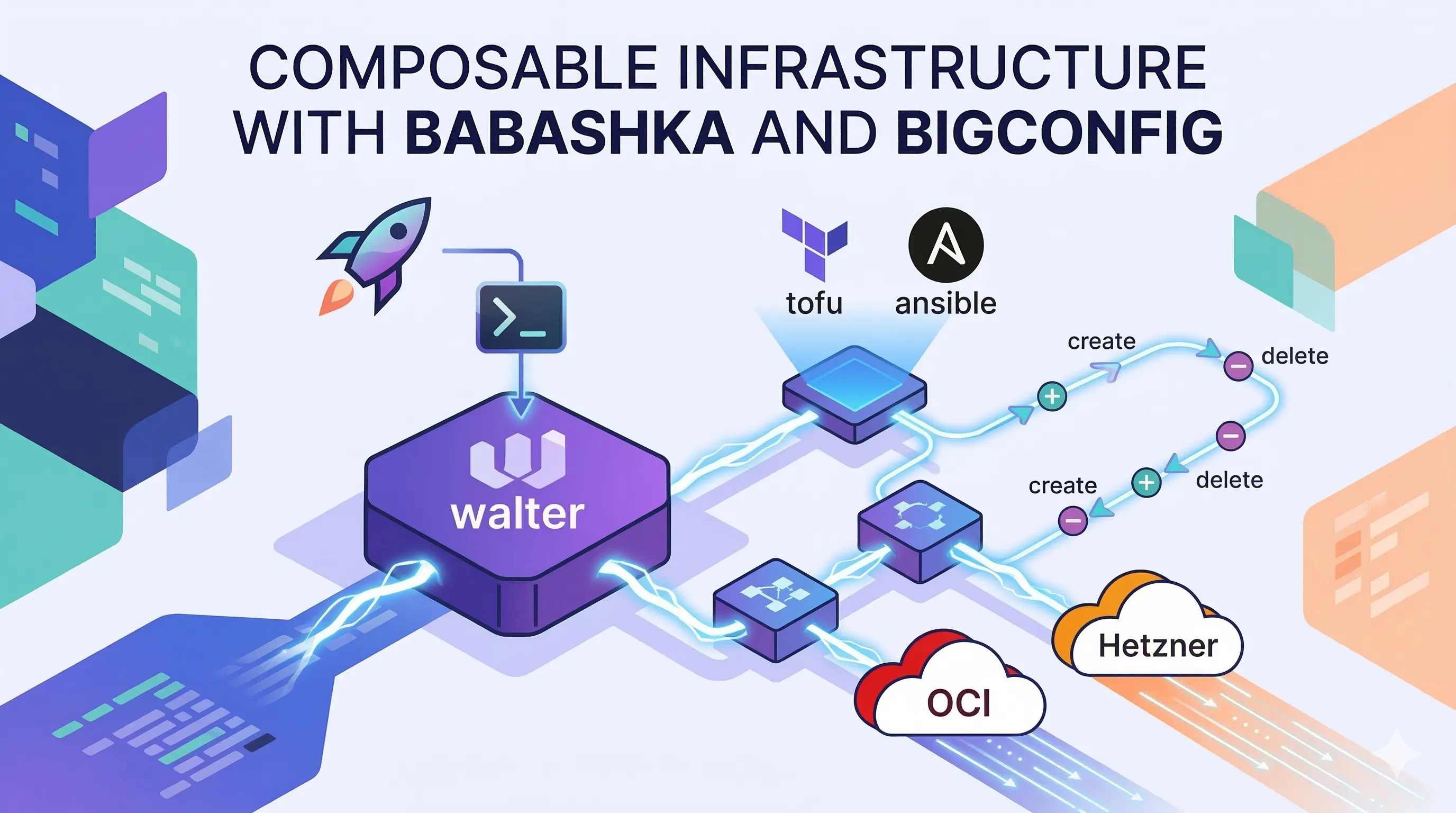
ansible

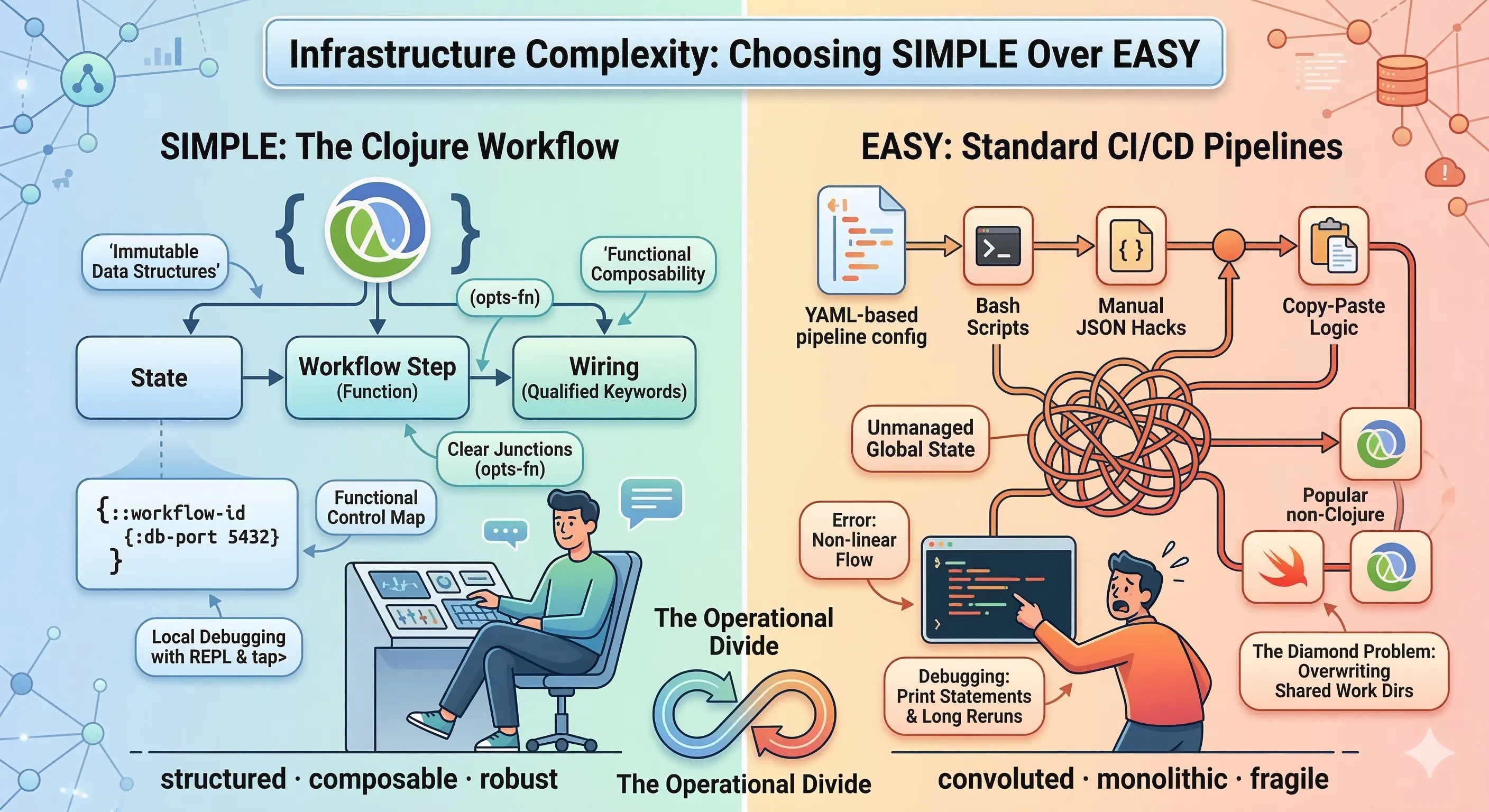
While “easy” tools often promise quick starts by mimicking familiar backend languages, they frequently buckle under the non-linear complexity of real-world infrastructure operations. This article explores why building a custom, data-driven workflow engine in Clojure—leveraging immutability, qualified keywords, and a robust REPL—outperforms “easy” alternatives for orchestrating tools like Terraform and Ansible. By prioritizing a simple architectural foundation over the easy path of standard CI/CD scripts, we gain the ability to handle complex branching, resolve state isolation through nested options, and achieve instantaneous debugging that “duct-tape” solutions simply cannot provide.

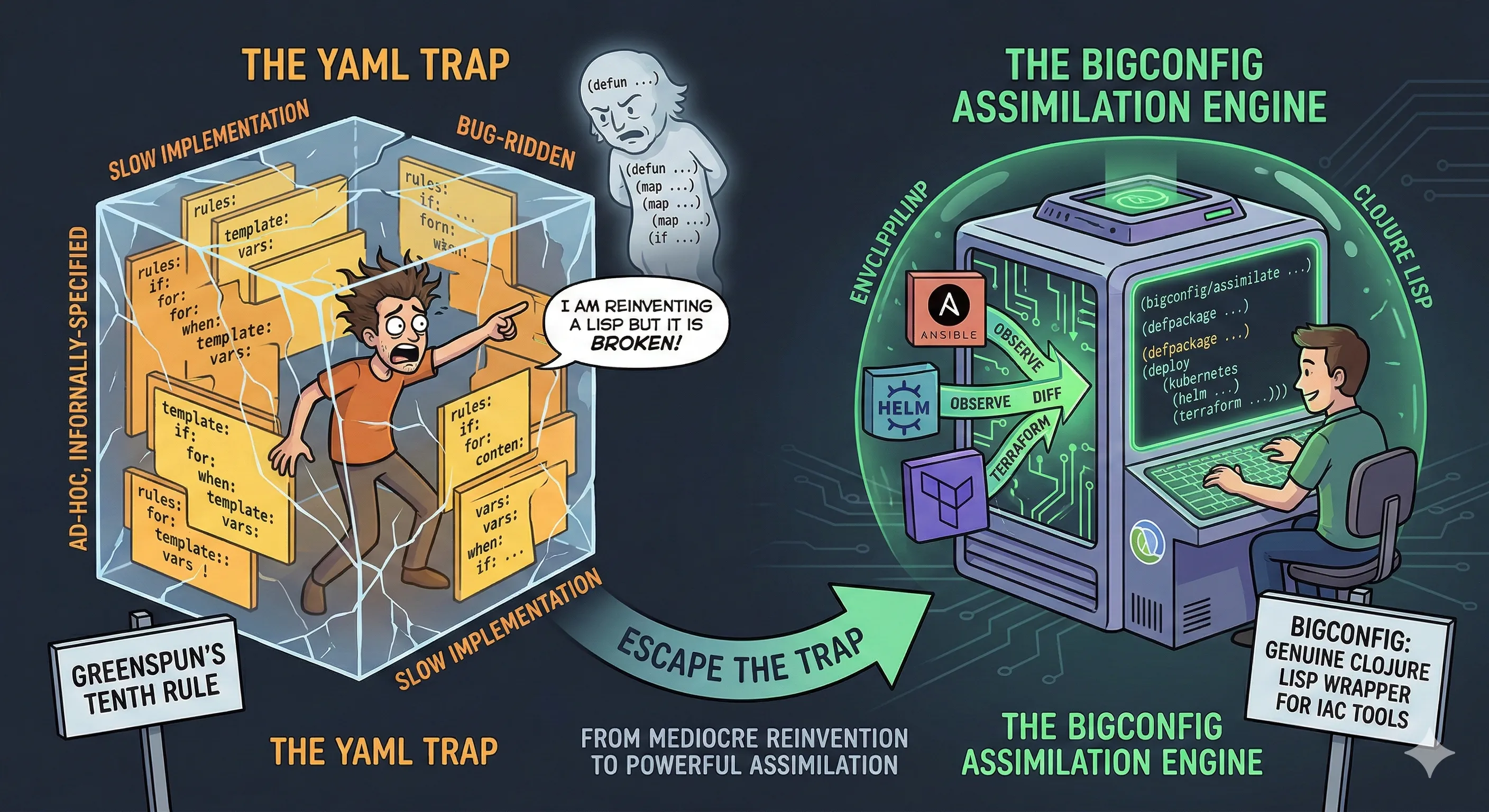
The YAML Trap: Escaping Greenspun’s Tenth Rule with BigConfig

K8s

Greenspun’s Tenth Rule warns that every complex system eventually reinvents a buggy version of Lisp. From YAML-hell in CI/CD to the “accidental” programming languages of Helm, Terraform and Ansible, the DevOps world is living this prophecy. Discover how shifting from rigid configuration to the power of Clojure and BigConfig can help you escape the trap of ad-hoc infrastructure logic.

Introducing BigConfig Package

K8s

BigConfig Package moves beyond the “Kubernetes-only” mindset of Helm by treating infrastructure and software as a single unit. By replacing specialized CLIs with Babashka (Clojure), it eliminates the friction between shell scripts and compiled binaries. This approach allows developers to move seamlessly between a CLI, a REPL for debugging, and a library for deep automation.

My Keyboard Endgame: 34 Keys, 3 Layers, and a Macropad

K8s

I spend a lot of time analyzing other people’s “endgame” setups, and I honestly don’t understand why so many users accept such steep learning curves.

The secret to a sustainable workflow is simplicity. If your layout is so complex that a month away from your desk “drives you nuts” when you return, it’s not an endgame—it’s a chore. Here is how I stripped my setup down to the essentials without losing productivity.

Replacing Integrant and Docker Compose with BigConfig System

system

BigConfig System is a Clojure library that unifies application architecture and infrastructure management into a single, programmable workflow, eliminating the friction of switching between the REPL and external tools like Docker Compose.

By treating system lifecycles as a sequence of code-driven functions rather than static YAML configurations, it allows developers to manage complex processes—such as dynamic Postgres initialization and teardown—entirely within a running session.

This “Emacs-style” approach favors high-granularity evaluation and real-time state inspection over heavy-handed namespace refreshes, consolidating the entire development stack into a single Clojure-based source of truth for improved introspection and speed.

Beyond the Shell: Reimagining DevOps with the Clojure REPL

dotfiles

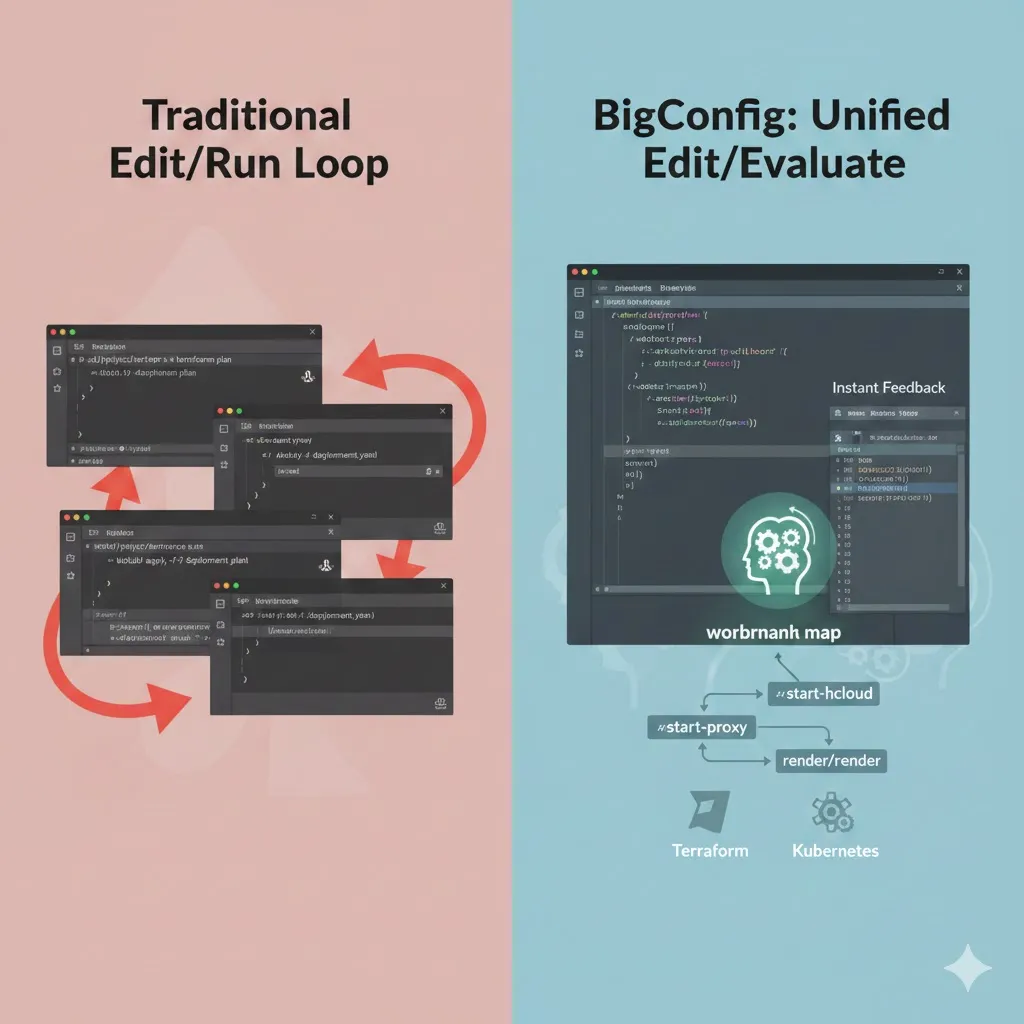
Traditional DevOps workflows are often bogged down by the “Edit/Run” loop, requiring developers to constantly switch between editors, directories, and terminal tabs.

BigConfig solves this by leveraging a persistent Clojure REPL to create a unified “Edit/Evaluate” environment.

By orchestrating tools like Terraform through a centralized “workbench map”, BigConfig eliminates context switching and replaces traditional debugging with instant, stateful feedback.

It transforms fragmented operations into a seamless, code-driven flow where infrastructure and development live in a single, interactive workspace.

Hypermedia: The New/Old Architecture Set to Revolutionize Web and Mobile Development

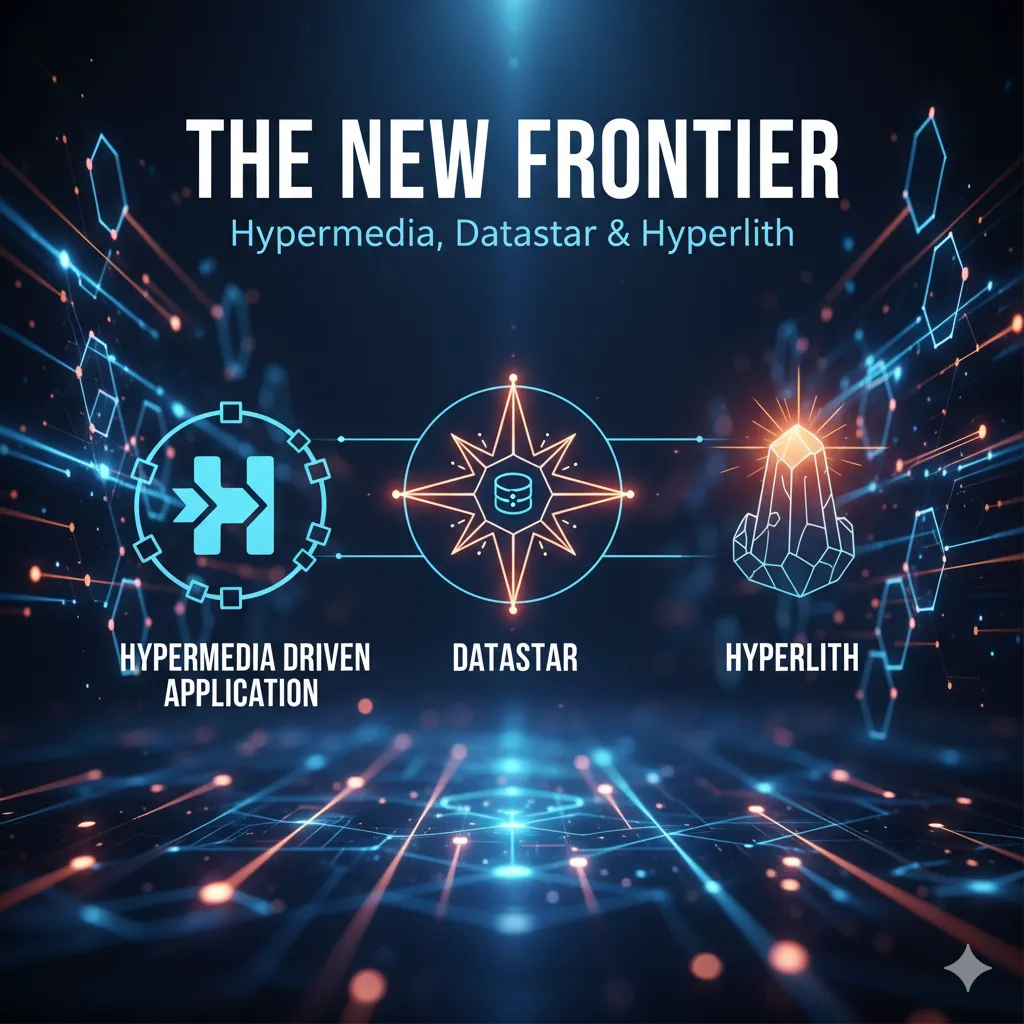
Hypermedia, Datastar, and Hyperlith

Hypermedia is the tech everyone is talking about, yet it remains a bit of a mystery for many. After diving deep, I’m convinced this new/old approach is not just a trend—it’s poised to disrupt how we build applications on both the web and mobile.

The strategic shift towards Hypermedia Driven Applications (HDA) fundamentally alters the economics of development, making internal solutions significantly more viable. As the cost of building web and mobile experiences drops, so too does the traditional calculus of “build vs. buy.

To capitalize on this change, our next major step is integrating Internal Developer Portal capabilities directly into BigConfig. This addition completes BigConfig’s transformation into the essential, comprehensive library for scalable operations, providing core building blocks like configuration as code, workflow orchestration, scaffolding, robust persistency, auditing, control planes, and now, internal developer portals.